
A Stone at the Edge of History
For over a thousand years, a mysterious, massive inscribed boulder stood at the mouth of the Singapore River — and then in 1843 the British blew it up!
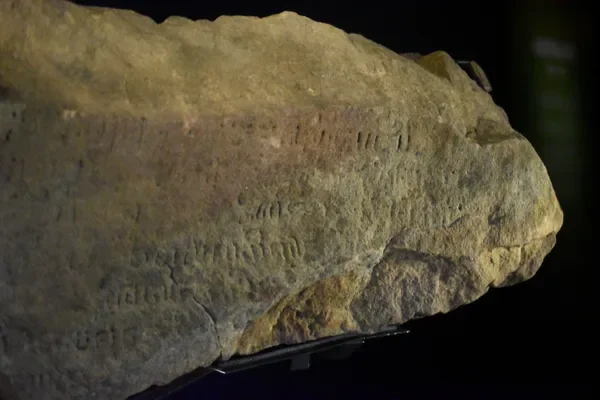
Imagine you are a labourer hacking through the jungle at the mouth of the Singapore River in June 1819. The air is thick and wet. Raffles has just planted his flag, and the island is being carved open for business. Your machete swings — and hits something that rings like a bell. You step back. There before you, half-swallowed by roots and time, is a sandstone boulder the size of a small house. And covering its face, from top to bottom, in fifty dense lines: writing. Strange, spiralling writing that nobody — not you, not your foreman, not the British officers summoned to see it — can read. It has been waiting here for centuries.
This is the Singapore Stone. And if you have lived your whole life on this island without knowing its story, I promise you: you are about to feel cheated out of one of the greatest secrets ever buried in plain sight.
The Giant at the River's Mouth
The stone was no modest artefact. At roughly three metres tall and three metres wide, it dominated the rocky promontory then called Artillery Point, at the very place where the Singapore River spills into the Strait. The inscription covered a surface 2.1 metres wide and 1.5 metres high — fifty lines of text carved with evident intention and craft, though with what one early observer tartly called "workmanship far ruder than anything of the kind I have seen in Java or India.".
That observer was the British Resident John Crawfurd, who noted in his 1822 journal that the inscription was already illegible as a composition. Even then, with the stone still standing, the centuries had done their work. Yet its presence was unmistakable — a monumental, deliberate statement in a script that straddled the edge of the known world. Who had put it there? When? And — most maddeningly of all — what on earth did it say?
Even Stamford Raffles, who prided himself on his knowledge of Malay civilisation, was defeated by it. He studied the stone and got nowhere. In 1837, a Royal Navy surgeon named Dr. William Bland made the first — and, it would turn out, most important — detailed facsimile of the inscription, pressing the surface to capture its characters before time erased them entirely. That facsimile, published in the Journal of the Asiatic Society of Bengal, would become the sole record of lines of text that no longer exists.
The Crime of 1843
What happened next is the kind of historical atrocity that makes archaeologists weep. In January 1843, Captain D.H. Stevenson of the East India Company decided the mouth of the Singapore River needed widening and that the area needed quarters for British Army commandants. The Singapore Stone was in the way. So he blew it up.
"A large block of the rock lay at the corner of Government House, where Fort Canning is now; but during the absence of the Governor at Penang on one occasion, the convicts requiring stone..."
— W.H. Read, who arrived in Singapore in 1841, describing the aftermath
The explosion reduced a thousand-year-old monument to rubble. What wasn't blasted was plundered. A large block sat neglected at Government Hill until it was quietly broken up and used as road gravel. One surviving fragment was discovered in the verandah of the Treasury, where — in a detail almost too perfect in its indignity — it had been serving as a seat for sepoys. It had spent centuries as a declaration of power; now it was a bench!
A Scottish military officer, Lieutenant-Colonel James Low, had loudly objected to the destruction. He was ignored. But in the aftermath, he salvaged three fragments and shipped them to the Royal Asiatic Society's museum in Calcutta for study. They arrived in 1848. In 1918, Singapore requested the fragments back. Only one was returned. The fate of the other two remains unknown to this day — lost somewhere in the labyrinthine archives of colonial India, rumoured by some to be in the Calcutta Museum archives.
A Script From Nowhere
Here is where the mystery deepens into something genuinely unsettling. The inscription on the Singapore Stone is not simply unread. According to one researcher, its writing system is "not compatible with any other script currently discovered" — meaning that if they are right, this inscription is the sole known example of its own writing system in the entire world. Not a regional variant. Not a corrupted dialect.
Most scholars, however, lean toward identifying the script as Kawi — a Brahmic writing system used across Java and parts of Southeast Asia between the 8th and 16th centuries. The language encoded in it remains unknown, with serious arguments made for Old Javanese, Sanskrit, and Tamil. In 2023, an analysis comparing the Stone to the Calcutta Stone of 1041 CE found numerous stylistic parallels, aligning it more specifically to the Later Kawi period of the 10th to 13th centuries.
But the most electrifying theory belongs to Australian researcher Dr. Iain Sinclair, who in 2019 identified a fragment of text that might read "kesariva" — likely part of the word parakesarivarman, a royal title used by kings of the Tamil Chola dynasty. If he is right, the Singapore Stone does not merely predate Raffles. It may predate the conventional founding of Singapore by the Malay prince Sang Nila Utama in 1299 by three hundred years — placing Tamil Chola influence at the Straits of Singapore as early as the 11th century.
The Legend of Badang the Strongman
Long before the scholars arrived, the stone had a story. According to the Sejarah Melayu — the great Malay Annals, the closest thing this region has to a foundational epic — Badang was a fisherman who ate the vomit of a river spirit (yuck!) and gained the strength of a hundred men. He became the champion of the Raja of Singapura, performing impossible feats before the assembled courts of India and beyond.
The tale most relevant to our stone: that Badang once hurled a massive boulder from Fort Canning Hill all the way to the mouth of the Singapore River. And on his death, two great stone pillars were raised over his grave "at the point of the straits of Singapura." Locals had always whispered that the Singapore Stone was Badang's stone. That the inscription was the mark of his impossible throw — a giant's autograph scratched into a river rock.
There is, of course, no archaeological evidence for this. But there is something deeply human about it: the desire to explain a thing so old and so strange that only myth can explain it. When you cannot read what a stone says, you let it say whatever the heart requires.
The Stone Today — and What Might Still Be Found
The surviving fragment sits in the History Gallery of the National Museum of Singapore, worn and small and quietly devastating — a chip off what was once a monument, fading further with every decade. The inscription on even this piece is vanishing. You can visit it. You can stand before it. You will not understand it.
But the story is not over. Researchers at Nanyang Technological University and elsewhere are developing machine-learning tools to "read" the surviving symbols, reconstruct missing characters from old facsimiles, and generate a complete recoverable text of all fifty lines. The idea is to assemble enough material for pattern recognition — to give the algorithms the puzzle pieces needed to begin seeing language where we see only shapes. It is, in a way, the Rosetta Stone problem: you need enough text to find the key. Right now, there is barely enough stone.
The Singapore Stone is, officially, one of this nation's eleven national treasures. It predates the colonial city, predates the Malay sultanate, predates perhaps the very name Singapura itself. It sat at the river's mouth for centuries, watching every trader, every sailor, every empire pass through the Strait — Srivijaya, Majapahit, the Portuguese, the Dutch, finally the British — and it said something to all of them. None of them could understand it. The British, characteristically, got rid of it.
What was written on that stone? We do not know. But the fragment is still here, in a glass case in a museum on an island that has remade itself a dozen times since the stone was carved — still holding its breath, still keeping its secret, still waiting for someone clever enough to ask it the right question.
The stone knew Singapore's name before Singapore did. One day, perhaps, we'll know its name in return.
Sources & Further Reading
1. John Crawfurd, Journal of an Embassy to the Courts of Siam and Cochin China, 1828.
2. Dr. William Bland, Journal of the Asiatic Society of Bengal, 1837, as cited in Laidlay (1848).
3. W.H. Read, quoted in the Singapore Stone Wikipedia entry; Governor Butterworth correspondence, 1843.
4. The Conversation, "The Singapore Stone's carvings have been undeciphered for centuries," December 2025.
5. Lee I-Shiang et al., "Unravelling the Mystery of the Singapore Stone," Histories (MDPI), August 2023.
6. Dr. Iain Sinclair, in From Sojourners to Settlers, ISEAS–Yusof Ishak Institute / Indian Heritage Centre, December 2019.
7. Sejarah Melayu (Malay Annals); also Omar, M. "Badang," National Library Board Singapore, 2006.
8. The Conversation / Academia.edu, research project at NTU Singapore and Xi'an Jiaotong-Liverpool University, 2024.
